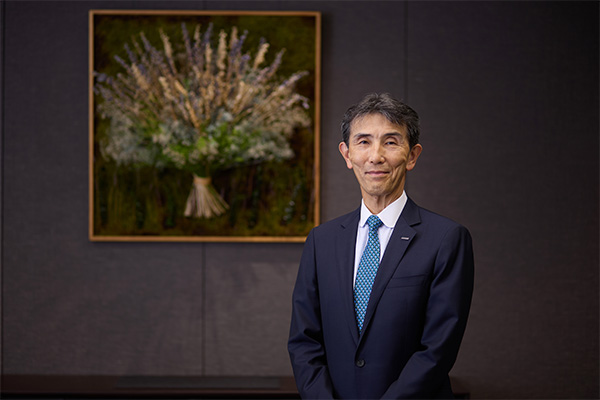
 President and Chief Executive Officer
Hiroaki Oda
We Will Continuously Solve Our Customers’ Issues. These Successive Efforts Will Make CSV Management Repeatable.
Under its Medium-Term Management Plan, Fuyo Shared Value 2026, the Fuyo Lease Group has positioned Creating Shared Value (CSV) at the heart of its management and has pursued business portfolio transformation and zone management. Now that we have entered the final fiscal year of the plan, I believe that the Group’s CSV approach has evolved beyond a mere principle into a value creation model that earns customers’ trust by solving their issues while generating both social and economic value. As customers’ issues become deeper, we are called upon to fulfill an expanding range of roles. I believe that continuing to meet our customers’ expectations will lead to our next stage of growth and enhance corporate value.
1. Review of the Medium-Term Management Plan – Becoming an Organization That Takes Ownership of CSV
Looking back on the past four years of the Medium-Term Management Plan, Fuyo Shared Value 2026, although there were lessons to be learned from the recognition of losses on overseas projects in the renewable energy business, I believe that, overall, we have steadily evolved from a strategic perspective. In particular, I feel that over this period, the foundation for value creation unique to the Fuyo Lease Group has finally taken hold within the organization. What I consider highly significant among these developments is that employees have gained a deeper understanding of Creating Shared Value (CSV). Initially, the term CSV did not readily take hold throughout the organization. While the concept of solving social issues while simultaneously creating economic value is important, it seemed somewhat removed from the day-to-day work of employees on the frontlines. In response, I communicated CSV in a way that would bring it closer to employees’ day-to-day work. In other words, I conveyed that solving customers’ management issues ultimately contributes to solving social issues while simultaneously driving business for the Group. Rather than presenting social issues in lofty terms, I emphasized that the first priority should be to address the issues faced by our customers. This way of thinking spread not only to sales and marketing divisions but also to the divisions that support sales and marketing and our Group companies, and a growing sense emerged among employees that their own work was helping to solve customers’ issues. I believe that the past four years have been a period in which we have moved CSV beyond the realm of principle and embedded it into concrete standards for action and decision-making.
2. Changes in Relationships with Customers
Another area in which I have seen tangible progress over the past four years is that the quality of our relationships with customers has changed. Even customers who previously viewed us strictly as a finance or leasing function now increasingly see us not merely as a funding provider, but as a partner that shares an understanding of their management issues and works continuously alongside them toward the solution of those issues. As a result, we have also had more opportunities to speak directly from this perspective with the top executives of companies with whom we had previously found it difficult to establish contact. This is not simply a matter of establishing a connection between top executives. When those leaders connect, frontline teams also feel more comfortable consulting with one another at an earlier stage. We are seeing an increase in relationships in which customers think, “Let’s consult Fuyo Lease first about this issue.” This is extremely significant for us. It means that we are expanding a customer base with which we can continuously co-create value, rather than merely undertaking one-off projects. I believe that this qualitative change in our customer base will become a source of competitive advantage that supports future earnings opportunities. I believe that what underlies these changes in our customer relationships is the CSV management that we have put into practice over this period.
3. CSV: Both a Principle and a Value Creation Model That Generates Earnings
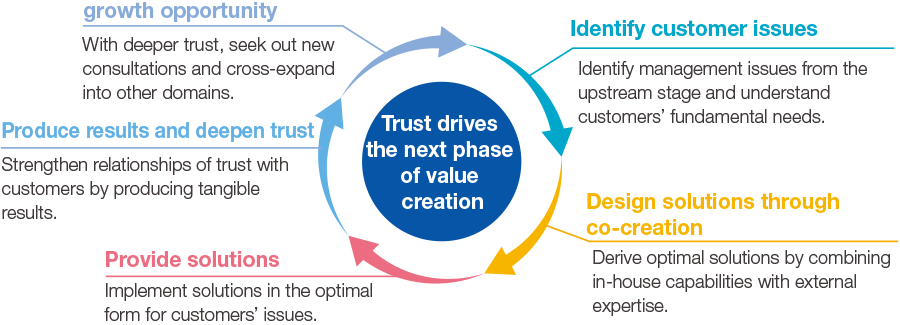
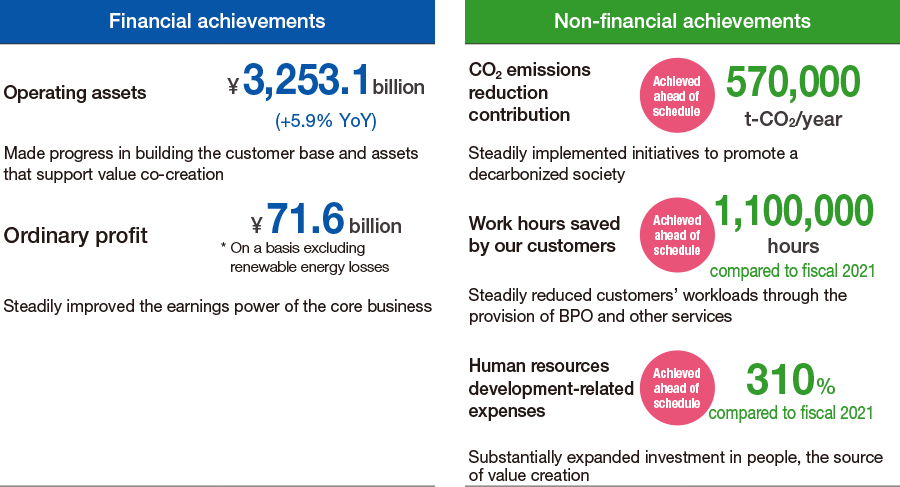
I view CSV as a form of management that earns customers’ trust by solving their issues while simultaneously generating both social and economic value. The key is to start with customers’ issues, rather than with social issues. We strive to gain a deep understanding of customers’ management issues and work toward solving them. As a result, our relationships of trust with customers will deepen, and new inquiries and projects will come to us at an earlier stage. This is the crucial point. If we compete only at the downstream stage of a project, it inevitably tends to become a competition on price. However, once we have established a relationship of trust, customers begin consulting us about their next project at an earlier stage. If customers consult us at a stage when their concerns are still somewhat vague, before they have been clearly articulated as management issues, we can consider solutions together with them from an upstream stage. This process involves co-creation, in which we develop solutions together with customers. From there, if we can turn those solutions into a tangible form and achieve results, trust will deepen further. Through this process, we can build relationships in which customers think, “Let’s consult Fuyo Lease again.” I believe that once the cycle of identifying issues, providing solutions, building trust, and securing the next opportunity is set into motion, CSV becomes more than just a principle; it becomes a repeatable value creation model. These activities are steadily being reflected in both financial and non-financial results. Looking ahead to the plan’s final fiscal year, we will continue to make steady progress in both financial and non-financial areas. In particular, in the non-financial area, we achieved the five-year targets for many indicators one year ahead of schedule. I believe that achievements such as increased investment in human capital, progress toward a decarbonized society, and reductions in customers’ workloads demonstrate that putting CSV into practice is strengthening our customer base and expanding earnings opportunities. I am convinced that the effectiveness of this value creation model will increase further as the environmental changes facing our customers become more significant.
4. The Roles We Are Called Upon to Fulfill Expand as Customers’ Issues Become Deeper
As we put CSV management into practice, we have found that the issues facing customers have also become deeper, broader, and more complex than ever, encompassing not only interest rates, prices, and geopolitical risks, but also green transformation (GX), digital transformation (DX), and labor shortages. That is why we are being called upon to fulfill an expanded range of roles. Amid these changes, the solutions we are expected to provide require more than just finance and leasing functions. I am not particularly attached to the expression “moving beyond finance and leasing” itself. What matters is providing the optimal solution to each customer’s issues. If customers have funding needs, we should fully meet those needs through our finance functions. This is a proven strength of the Fuyo Lease Group. Meanwhile, it is also true that an increasing number of issues cannot be solved through finance and leasing functions alone. For this reason, while building on our strengths in finance and leasing, we have expanded our capabilities into adjacent areas and enhanced our ability to solve customers’ issues. As future growth domains, I believe that areas such as logistics, mobility, and urban development have significant potential. For example, in logistics, initiatives to engage more deeply with frontline operational issues are expanding through collaboration with Group companies and partners. Each of these is a domain in which customers are facing a growing range of issues against the backdrop of changes in social and industrial structures. They are also domains in which the Fuyo Lease Group can effectively leverage its strengths by combining its finance function, asset expertise, and network of business partners. Rather than simply expanding into new domains, we will carefully identify the domains in which we can provide solutions unique to the Fuyo Lease Group in response to customers’ issues, thereby driving our growth. As customers’ issues become deeper and broader, there will also be an increasing number of domains where solutions cannot be provided by the Fuyo Lease Group alone. Since we are not a technology company, we cannot maintain all the necessary capabilities in-house. Therefore, alliances and M&A with companies that possess technologies and expertise will be crucial. These companies, in turn, will approach the Fuyo Lease Group in the expectation that we can provide capabilities that they do not possess. We will solve issues by bringing together our respective strengths. I believe that these successive efforts will ultimately contribute to solving social issues. That said, as issues become increasingly sophisticated, we ourselves, as providers of solutions, will be expected to possess a higher level of expertise.
A Positive Cycle of Trust and Growth Beginning with Solving Customer Issues
Achievements in Driving CSV Management
5. We Cannot Solve Customers’ Issues Without Being Professional
The large losses we incurred in the renewable energy business in the previous fiscal year taught us an important lesson about entering new businesses. As management, we take seriously the impact of these substantial losses on our financial results. At the same time, we reaffirmed our recognition that, when venturing into new growth domains, it is essential to incorporate and secure the necessary professional expertise in various ways while advancing these efforts in tandem with raising the sophistication of risk management. By approaching our businesses, including the real estate field, as professionals, we are able to evaluate projects while anticipating a wide range of risks. As we continue to pursue our corporate slogan, “Go Where No One Has Gone Before,” we intend to maintain a strong awareness of this professional perspective. Through these initiatives, we will establish a structure that enables the Fuyo Lease Group to provide value at an even deeper level.
6. People and Organizations Establish the Repeatability of Value Creation
This value creation is ultimately supported by people. I believe that human capital is the foundation for value creation in CSV management. We are focusing on investment in human resources. Under the Medium-Term Management Plan, we set a target of increasing human resources development-related expenses per employee to 300% of fiscal 2021 level. We have already achieved this target ahead of schedule. Over the past four years, I have focused particularly on creating an environment in which employees can confidently take on new challenges. By fostering a corporate culture that ensures psychological safety and values diverse opinions, we have sought to build an organization in which new insights and proposals can emerge. I now feel that we are moving a step further and evolving into an organization that thinks deeply. For some time, I have repeatedly told employees that I want them to become experts at bouncing ideas around. They can bounce ideas off AI, a supervisor, or even themselves. The important thing is to put their ideas to the test, think them through again, and then take them one step deeper. By repeating this process, they can steadily improve the quality of their proposals and hypotheses. I tell employees, “Use AI as much as you can. However, at the end of the process, you must think for yourself.” Is this really the right proposal for addressing the customer’s issue? Why are we making this particular proposal? Is there another way of looking at it? Employees can bounce ideas off other people or AI. However, it is important that they ultimately arrive at an answer of their own. Our customers will also sense that the person has genuinely thought through their issue. These successive efforts build trust. We have also recently been promoting AI-enabled knowledge sharing. By analyzing past proposals and project data, we are making it possible to utilize the knowledge and expertise of other divisions and Group companies across the organization. Employees can now recognize that information they might have previously dismissed as irrelevant to them could, in fact, be useful to their own customers. I see this as encouraging employees to take ownership of information as personally relevant to their work. I believe that strengthening our human resource and organizational capabilities in these ways will ultimately enhance our ability to develop proposals and generate projects, thereby leading to the Group’s growth.
7. Advancing to the Next Stage – Achieving Sustainable Growth and Enhancing Corporate Value Based on Trust
I want us to become the business partner most trusted by our customers. To achieve this, we must become a partner capable of addressing customers’ issues more deeply and across a broader range of areas. Looking ahead, we will expand the range of issues we can solve while carefully identifying domains with substantial growth potential for us, including logistics, mobility, and urban development. In this process, it is essential that we maintain an unwavering focus on solving customers’ issues. These successive efforts will ultimately build trust, generate earnings, and create new growth opportunities. I intend to further strengthen this positive cycle. At the same time, I believe that management has a responsibility to shareholders and investors to convert these value creation initiatives into solid earnings growth and improved capital efficiency. To this end, we will continue reviewing our business portfolio, replacing assets, and raising the sophistication of risk management, with the aim of achieving both sustainable growth and increased corporate value. There has been no change in our fundamental approach of creating trust and growth by solving customers’ issues. While further enhancing the quality of CSV management, we will build the Fuyo Lease Group into an organization capable of driving this positive cycle with even greater repeatability. This is the Fuyo Lease Group’s determination as it advances to the next stage.